Marshall University Athletics
COTTON: Chambers' Play Still Towers over Marshall Football
11/5/2015 12:00:00 AM | Football
By STEVE COTTON
Photo Gallery
HUNTINGTON, W.Va. ââ'¬" Upon the 100th anniversary of the most renowned touchdown in Marshall history ââ'¬" indeed one of the most famous plays in all of football in the early 20th century ââ'¬" this seemed to be a good time to do some research regarding the famed "Tower Pass" of Nov. 6, 1915, against West Virginia University.
The following account has been assembled using information from the Marshall University archives, yearbooks, newspaper microfilm, Dr. Charles Hill Moffat's book, "Marshall University: An Institution Comes of Age," and early Spaulding's Football Guides and Walter Camp's football rule books. The study adds several interesting details to the accounts that have been told in recent years, and also bursts some myths that have developed over a century's worth of recounting the tale.
Setting the stage
In 1915, Marshall was a so-called normal school, with a preparatory high school designed to get students ready for a four-year college or to remain at Marshall to earn a two-year teaching degree. The enrollment for the high school and the college was a combined 880. Marshall began offering four-year degrees in 1920.
Marshall's athletic teams featured high school and college students, and with no real eligibility standards in place, it was common for athletes to play for several years on the varsity. Some even went to school in the fall to play football, then would go get a job in the spring and summer, returning to go to school and play football again the next fall.
Despite the fact that his team included high school students, Marshall Coach Boyd Chambers was intent on building a schedule of competition against four-year colleges and had halted the practice of playing local high schools. Prior to the WVU contest, Marshall had lost all four of its games that year by a combined 117-0 against Denison, Marietta, Washington & Lee and Otterbein.
In contrast, West Virginia expected 1915 to be a banner campaign. Alumni displeased with some mediocre football seasons had pushed the school to hire a nationally prominent coach after the 1913 season. WVU turned to Sol Metzger, who had coached Penn to the 1908 national championship.
Metzger's second team seemed poised for greatness but had gotten off to a disappointing start with a 7-0 loss to Penn and a 6-6 tie with Washington & Jefferson. WVU beat Geneva 33-0, but then suffered a forfeit loss at W&L when Metzger pulled his team from the field with an 8-6 lead, alleging "rough play" by the Generals.
The coaches
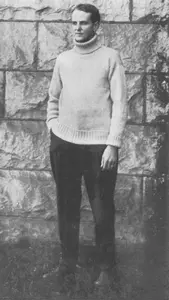
Boyd B. Chambers was a Marshall alumnus who had played football and baseball at the school from 1900-02, then went on to earn his four-year degree at Denison University. When Marshall decided to get serious about athletics, Chambers was hired in 1908 as the first full-time athletic director and to coach the football, basketball and baseball teams.
He fenced in an athletic field and erected bleachers on what is now Buskirk Field, behind the Marshall Science Building, and started charging admission to sporting events. Known as a wily competitor, Chambers by 1915 had already long been known by the nickname "Fox."
With perpetually youthful and undersized teams relative to the opposition, Chambers shunned traditional, straight-ahead, power football in favor of speed, skill, deception and the nascent passing game. He gained a reputation as an innovator who created multiple formations to force the other team's defense to spread out over the entire field and was an avid practitioner of the screen pass invented by Pop Warner at the Carlisle Indian Industrial School.
Sol Metzger played football at Penn for Hall of Fame coach George Woodruff. He became a successful coach himself, but never stayed very long at one place, serving at Baylor, Oregon State, Penn, WVU, Washington & Jefferson, Union and South Carolina over a 20-year career, during which his teams went 69-41-8.
Metzger, too, was known as a fierce competitor, and after the Mountaineers forfeited the previous game was described in the Huntington Advertiser as, "the fiery-headed coach of the West Virginia squad who gained more fame in three minutes of a recent rules discussion than an average coach can accumulate in three years of hard work."
The key performers
Bradley Workman was the oldest of five football-playing brothers in Huntington. It seems the sons of Albert Workman had no other choice, as demonstrated by this quote from a 1920 story in the Herald-Dispatch: "'You gotta make your football letter before you wear long pants,' is the standing edict in the Workman family from 'Pa' Workman. Consequently, all five of the brothers have sparked in the gridiron togs in high school before they were out of knee breeches."
Okey "Blondie" Taylor was from Clendenin and had played football at Morris Harvey College, starring on the 1912 team that received high praise for putting up a strong fight in a 39-0 loss at Notre Dame ââ'¬" against the first Fighting Irish team to own a perfect season. Taylor later enrolled at WVU and joined the football team, but was declared ineligible because his Morris Harvey credits didn't transfer. He decided to continue his education at Marshall. It was said that some of the Mountaineers were looking for an opportunity to "get at" Taylor during the game.
Dayton "Runt" Carter was a 16-year-old high school student, a member of the team but one who didn't get to play much because of his (lack of) size.
He was described in Dr. Moffat's book by longtime Huntington sportswriter and sportscaster Fred Burns as "undersized, but an accomplished acrobat and tumbler." In the Herald-Dispatch, Carter was labeled "about the size of a healthy cake of soap."
The officials
The referee who had no idea what he'd be walking into that Saturday was Mr. H.M. Butler of Brown University, a national administrator with the Boy Scouts of America. It was written prior to the game that Butler was "one of the most noted playground authorities in America and a great official." John R. Hayes of Virginia was the umpire, and the head linesman was Larry McClure, a Wayne native who had been a star pitcher at Amherst College and briefly played Major League Baseball with the New York Highlanders in 1910.
The buildup
This was the biggest sporting event in Huntington's history. The city included supporters of each school as WVU featured a half-dozen locals who had gone to Morgantown to play at the four-year institution. The Mountaineer fans also were out for some Marshall blood after Chambers' Big Green had upset WVU to win the state baseball championship the previous spring, and they were certain they'd soon have something to crow about to their Marshall neighbors. More than a few had also lost part of their paychecks because of that baseball game ââ'¬" money they planned to recoup on the gridiron.
An Advertiser story quoted the West Virginia press bureau as declaring that, "The Marshall game will be regarded by coaches as a practice battle ââ'¬Â¦ a practical tryout to numerous new plays devised particularly for use against Wesleyan on Thanksgiving day."
Several outlets reported that Metzger said, "I'll eat my hat if Marshall even scores."
The average weight of the Marshall starters was 158 pounds, 20 below the average of WVU, and the Mountaineer linemen outweighed Marshall's by 30 pounds per man. If that weren't enough, fullback Everett Lawrence, described as Marshall's best athlete, was called home to Kanauga, Ohio, that week to be with his dying father and would miss the next three games.
There was said to be heavy wagering on the game, not as to who would win but whether Marshall would even score. Boosters of the Green and White gained hope when word spread that "Fox" was up to something.
Chambers also was on guard against potential WVU spies at practice: "A German battalion, headed by a Krugg gun, would have trouble forcing its way into Marshall field this week. At each portal big, brawny lads are on guard and a mysterious acting person snooping around Marshall field might just as well turn in his checks," wrote the Herald-Dispatch.
As interest in the game peaked, a "special" train was scheduled to transport spectators from Charleston, and Marshall arranged for a convoy of automobiles to shuttle patrons from downtown Huntington to campus.
West Virginia took a Pullman train from Morgantown to Parkersburg, where it spent the night, and made the rest of the trip to Huntington on Saturday morning.
Nov. 6, 1915
Saturday morning featured a downtown parade and a contest for the best storefront window decorations. Nearly everyone in the city wore flowers, white carnations for the Marshall faithful, while WVU rooters donned yellow chrysanthemums.
After the game, the Marshall faculty hosted a reception to introduce new President O.I. Woodley and his wife, an event attended by all state and city officials of note and called by the Herald-Dispatch, "the biggest school affair ever staged in the state."
Eventually, the throng made its way to the campus field and a 3 p.m. kickoff for the main event. The West Virginia supporters ââ'¬" including those with a financial interest ââ'¬" felt good about life as the Mountaineers rolled to a 38-0 lead in the second quarter while Marshall managed but a single first down. That's when the Big Green made history.
The ensuing Mountaineer kickoff rolled into the end zone for a touchback and Chambers instructed his quarterback to employ the team's "Spread Eagle Formation" and strike the Mountaineers with a barrage of passes.
On the first play, Workman hit right halfback Don Bates for a 15-yard gain. A pair of screen passes to 142-pound left halfback "Puny" Callaway ââ'¬" the youngest member of the squad and "hidden behind three blockers" ââ'¬" advanced Marshall near midfield. The Mountaineer defenders were said to be out of breath from suddenly having to chase Marshall all over the field.
Workman stayed on the attack by connecting with end Hugh Davisson for a 20-yard pass and then hit Callaway for 30 more, ahead to the Mountaineer 3-yard line. With WVU's defense scrambling, Chambers replaced Davisson with the diminutive Carter. According to the Herald-Dispatch, the crowd, "uttered words of pity that such a youth as Dayton Carter was being sent in when men of such calibre were playing."
On first and goal, Marshall tried to score on a run, but fullback Lee "Slim" Bonar was stuffed at the line of scrimmage. The Fox's trap was fully set.
Workman took the second down snap and dropped to pass, scrambling against a rush made all the more fierce because his right tackle didn't bother to block. "Blondie" Taylor instead hustled to the end zone, just to the left of the goalpost, where the acrobatic "Runt" was quickly hoisted onto his shoulders. With the defenders closing in, Workman was able to get rid of the football just in time and just close enough to his target. Carter made a lunge, caught the pass and fell at Taylor's feet, inches across the goal line.
Marshall fans celebrated while the Mountaineers fumed, and none more than Metzger. The West Virginia coach's arguments ranged, and raged, from technical ââ'¬" since he was on Taylor's shoulders, Carter wasn't even on the field of play when he caught the pass ââ'¬" to a general plea of unsportsmanlike play on Chambers' part. Referee Butler pointed out that any receiver who leaps to catch a pass is not on the field, either, and let the play stand.
After several minutes of futile arguments, the seething Metzger poured it on against Marshall right to the game's very end, mounting a 92-6 victory.
It's safe to say, however, that there has never been a group of fans with bigger smiles, or fatter wallets, after such a beating as the Big Green was that afternoon on Campus Field.
The aftermath
Down through the annals of West Virginia's history will go the story of a gridiron conflict in which Marshall College clashed with West Virginia university, when, with the score overwhelmingly against them and certain defeat a matter of fact, the Green and White eleven took a brace, completed five forward passes, carried the ball to within West Virginia's three yard line from where a forward pass was made that shocked the world. The goal was not kicked and Marshall's total for the afternoon's work was six points yet Boyd Chambers, who up to the time had gained the title of "Old Fox" will be known forever as "King of Foxes."
--Herald-Dispatch, Nov. 7, 1915
Metzger and the Mountaineers continued a rampage through the rest of their schedule, beating Virginia Tech, Marietta and West Virginia Wesleyan by a combined score of 77-0.
Marshall lost the next week, 13-6, to Davis & Elkins in a game played in Clarksburg, then fell at Ohio University 18-6 before snagging its only win of the season as it closed the year with a 61-7 win over Kentucky Wesleyan.
Okey Taylor missed the D&E contest and saw limited time against Ohio because of injuries suffered in the WVU game. Chambers did not coach Marshall during its Thanksgiving Day victory; he spent that day, ironically, as the head linesman for a game played in Fairmont ââ'¬" between WVU and West Virginia Wesleyan.
Separating fact from fiction
It has been reported over the years that Marshall scored its only touchdown against Ohio with the Tower Pass and attempted it again, unsuccessfully, against Kentucky Wesleyan. Detailed accounts from each game, though, do not mention the play. It seems unlikely the use of the play would be ignored, given that it had received national notoriety. In the Ohio game, the lone Marshall touchdown is explicitly described as a run by "Rags" Raper.
It has also been reported that Metzger and Ohio Coach Mark Bank appealed after the season to Yale's Walter Camp, the head of the rules committee, to have the touchdowns taken away retroactively, and that Camp allowed the scores to stand but immediately put in place a new rule outlawing the play for 1916.
This, too, is inaccurate.
In the 1916 Spaulding's Official Football Guide, edited by Camp himself, a section of the book praised Chambers for his innovation and exciting style of play, specifically the way Marshall, "advanced the entire field for a touchdown against West Virginia University all by passing, without gaining a single yard by straight football."
Instead of implementing a rule against the Tower Pass, Camp said that it remained legal for 1916 and would require more study and thought in the future.
The Approved Rulings section at the end of the 1916 book includes the following:
If a player catches a forward pass while he is on the body or shoulders of another person of his side, the catch shall be allowed, provided the latter player does not assist the catcher to advance by any positive motion.
In a review of Huntington newspaper recaps (Herald-Dispatch and Advertiser) of 1916 Marshall games, there is no mention of Chambers' team using the Tower Pass again. That also was Chambers' last season as the Marshall coach.
It also has been reported repeatedly over the years that Chambers first added uniform numbers to Marshall jerseys in 1916. However, the Nov. 5, 1915 edition of the Advertiser listed rosters for both teams, complete with jersey numbers.
Whatever happened to ââ'¬Â¦
Boyd Chambers coached at Marshall for one more season, then moved on Bethany College for a year and eventually to the University of Cincinnati, where he served as athletic director and coached the football team from 1918-21 and the basketball team from 1918-28. He then opened a sporting goods store and served for many years as a college football official.
Chambers died in 1964 at the age of 79; he was inducted into the University of Cincinnati Athletic Hall of Fame in 1977 and the Marshall Athletic Hall of Fame in 2003.
Bradley Workman's Marshall career was just getting started in 1915. A star on the baseball diamond as well as the gridiron, Workman's final season as the Big Green quarterback was 1919, when he led Coach Archer Reilly's squad to a perfect 8-0 campaign during which Marshall outscored the opposition 302-13. Workman lived in Huntington his entire life, working at Central Glass Co., and died at age 71 in 1967. He was inducted into the Marshall Athletic Hall of Fame in 2004.
Noel Workman came to Marshall as a high school student for the 1916 season and caught 14 touchdown passes in that year ââ'¬" a school single-season record until Troy Brown had 16 TD receptions in 1992. Noel then transferred to Bethany, following Chambers, playing in 1917. He returned to Huntington in 1918 when Chambers went to UC.
Noel and Hoge went to Ohio State in 1919 and starred for the Buckeyes. Hoge was called by Michigan Coach Fielding Yost, "the best passing quarterback in the entire nation." Hoge won All-American honors, with Noel catching many of his passes.
Like Bradley, Hoge was also a baseball star who, in 1924, both pitched a few games for the Boston Red Sox and that same fall won second-team all-NFL honors as a player-coach for the Cleveland Bulldogs. Noel would later become the head football coach at Iowa State.
Huntington High School celebrated the end of the 1920 season by holding an alumni game and calling the occasion "Workman Appreciation Day."
Okey Taylor became the only Marshall player named to the 1915 All-State College Team and he was called "likely the finest tackle ever to put on a uniform in this state." Six of the 11 on that team were Mountaineers. Among those was Clay Hite, a halfback from Huntington.
The quarterback for WVU ââ'¬" he scored three touchdowns that day ââ'¬" was Ira Errett Rodgers, who later became an All-American fullback and a storied Mountaineer coach.
As for Taylor, he returned to live in Clendenin after graduating from Marshall. He died at age 45 in 1938. Dayton Carter grew enough ââ'¬" at a listed weight of 132 ââ'¬" to receive regular playing time the following season, and scored five touchdowns in 1916. We have been unable to find any record of Carter after the 1916-17 Marshall school year.
Even while Sol Metzger was coaching football, he doubled as a sportswriter. After retiring as a coach at South Carolina following the 1924 season, he turned to writing as a full-time career. For many years, Metzger wrote a nationally syndicated sports column, authored a book entitled "How to Watch Football," and co-wrote "How to Play Golf" with famed sportswriter Grantland Rice.
The fate of Metzger's hat remains a mystery.
Veteran play-by-play broadcaster Steve Cotton ââ'¬" a record 10-time West Virginia Sportscaster of the Year ââ'¬" is in his 23rd season on the Thundering Herd/IMG Sports Network. A version of this story first appeared in this week's Herd Insider.