Marshall University Athletics
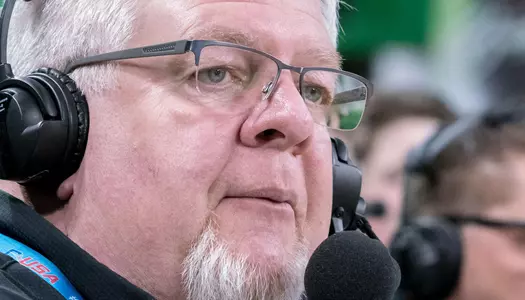
MCGILL: Cotton reaches milestone behind the microphone
4/14/2020 1:19:00 PM | Football, Men's Basketball, Big Green Scholarship Foundation, Word on the Herd, Ticketing & Promotions
Voice of the Thundering Herd called 1,000th game at Marshall
Note: This story originally appeared in the December 2019 issue of Thundering Herd Illustrated, the official magazine of Marshall University Athletics. Steve Cotton, the Voice of the Thundering Herd and a 14-time winner of the West Virginia Sportscaster of the Year award, finished the 2019-20 athletics calendar with 1,017 games called.
By Chuck McGill
Inside Crawford School, a one room schoolhouse that hugs a two-lane road east of Kalkaska, Michigan, the interests of a young Steve Cotton caught the eye of the county librarian.
Every other week, Mrs. French would visit the little school and read a chapter or two, and then pass out books of varying interests to children in a small building that housed 25 to 40 students, depending upon the year. The librarian knew Steve had an affinity for baseball, so she would bring him reading materials from America's pastime and other sports, a gesture that serves as the foundation for the person he is today.
In that schoolhouse, Steve learned to read. He indulged in sports, especially his first love of baseball. He developed a thirst for knowledge and the persons who came before him. He noticed the sports heroes in the pages of those books – long before the advent of free agency – were devoted to one team. His little heart grew sad when he would read about Ty Cobb spending the 1927 and 1928 seasons with the Philadelphia A's after playing for the Detroit Tigers since 1905, or how George Herman "Babe" Ruth had to ditch pinstripes and spend a season with the Boston Braves as a shell of himself.
Why couldn't these behemoths of baseball be like his broadcast hero, Ernie Harwell?
Mr. Harwell joined the Tigers' broadcast crew in 1960, and spent all but one of the next 42 years calling games on television and radio for Steve's favorite team. In 1971, when Steve turned 7 years old, he received a transistor radio as a birthday present.
"He would curl up on the couch and watch or listen," Norma Cotton, Steve's mother, recalled. "Ernie Harwell was his favorite, his hero."
The proximity of the Tigers' radio booth to the field brought the game to Steve. He could hear the vendors peddling peanuts and ice cold beer, and he'd listen as Harwell, with his Georgia drawl, described the action in detail.
"I remember lying in bed and I came across a Tigers game and was just enthralled by it," Steve said. "From that first night, I kept going back and learning. I was a fan of sports on the radio before I was a sports fan."
These days, Steve is the Voice of the Thundering Herd. Since 1996, he has been the play-by-play radio voice for Marshall University football and men's basketball, never missing a football game in those 24 seasons. He hit a milestone in October, calling his 300th football game at Marshall. On Jan. 4, 2020, barring something unforeseen, Steve will reach another significant number: 1,000 broadcasts, football and men's basketball combined.
"Huntington is a special place and there's no place like Marshall University," said Stan Cotten, Steve's predecessor and the person who recruited the Herd's current radio voice here. "Steve realized that right away and latched onto that. Marshall has an all-time great broadcaster sitting in that chair."
***
Steven Glenn Cotton was born on May 12, 1964. His dad, Glenn, worked on a farm, and few people around Steve shared his interest in sports.
The schoolhouse was too small for sports teams, although he and his classmates would play ball at recess. Sometimes, Steve and a friend would ride their bicycles five or six miles to a country store and buy baseball cards.
"He would play out in the yard by himself with a baseball for hours," Norma said. "That was his main interest."
Because the farm could not support growing families, Glenn went to work for Bear Archery, where Norma held a job in the accounting department. In 1978, when the company relocated to Gainesville, Florida, the Cottons moved to the Sunshine State. Steve had a knack for math and science, so he decided to attend nearby University of Florida and pursue electrical engineering.
Steve had an interest in broadcasting, but he was practical. In his baseball-first mind, he thought about his beloved Tigers. The players who had worn the old English D were in a select group, yet he had followed dozens and dozens from boyhood until it was time to reach college. In all that time, with all those players, there had been only one Tigers broadcaster.
"I thought broadcasting would be fun and Ernie Harwell had the greatest job of all time, but I also realized the odds," Steve said.
About halfway through his junior year at Florida, Steve no longer wanted to pursue electrical engineering. He decided to give broadcasting a one semester trial, and if it did not work out, he would return to his original major and shift his focus to mechanical or civil engineering.
"I took the classes, loved it and got involved at the radio station at UF," Steve said. "I kept on."
He then informed his mother of the shift in his pursuits.
"He came home and told me he had switched his major to communications," Norma said. "Mother was not happy."
She warned her son that he could be headed toward a career that was not as lucrative, and then she recalled how her son responded to those words.
"I don't care," Steve said. "I'm going to be happy."
***
Steve's journey to Marshall began in the yellow pages of a phonebook in Knoxville, Tennessee.
It was May 11, 1987, a day shy of his 23rd birthday, and Steve had been in Nashville as part of the baseball broadcast team calling Florida's regular season finale at Vanderbilt. In the pre-Internet days, it was a challenge to find vacancies in the radio business. He cold-called and wrote letters, but had nary a lead. So he checked into a hotel in Nashville after an 8-6 Gators win, and the next morning he called station after station looking for work. The next day, he drove to Knoxville, spent the night, and again woke up to call every radio station listed in the yellow pages.
"It was literally the last station listed that I could have called," Steve said. "They didn't have anything, but they had heard of a guy in Jefferson City looking for a news and sports guy."
He called, talked to the general manager and immediately made the trip to Jefferson City – 16 years to the day after receiving his first transistor radio. The next Monday, after the SEC baseball tournament in Athens, Georgia, the general manager called and offered Steve a job. Steve packed up his Nissan pickup and headed there, where he would call Carson-Newman games and meet Stan Cotten. When Stan called games on the NBC affiliate in Knoxville, Steve handled the radio play-by-play. On radio-only broadcasts, Stan handled the play-by-play and Steve was the color analyst.
After four years, Steve returned to Gainesville, and a year later, Stan headed to Marshall. It was then that Steve mulled graduate school and his options beyond broadcasting, and Stan convinced then-Athletic Director Lee Moon to bring Steve to Huntington to help with broadcasts. In 1993 and '94, Steve handled sideline work at Marshall. In 1995, Steve became the color analyst, and when Stan started doing games Marshall produced for television, Steve handled play-by-play duties on the radio.
Stan then departed for Wake Forest, where he still works as the Voice of the Demon Deacons, and Steve took over at Marshall. Steve felt the weight of expectations following in the footsteps of Jim Thacker, Gene Morehouse, Frank Giardina, Bill Roth, Wes Durham and Stan Cotten.
Marshall finished Steve's inaugural football season behind the microphone 15-0 and won the I-AA national championship.
"I was kind of nervous," Steve said. "We already knew they were all great broadcasters, but there's no better way to make people think you're doing a good job than to say "Touchdown, Herd" over and over again."
***
In Huntington, Steve Cotton found his home.
When he was at the University of Florida, he would interview legendary broadcasters from opposing teams. Florida had Otis Boggs from 1940 to 1981, before Steve stepped on campus. Tennessee's John Ward was the Vols' voice for more than three decades. Larry Munson was in Georgia's radio booth into a 43rd season. Cawood Ledford was Kentucky's voice for 39 years.
Ernie Harwell is Steve's all-time favorite and he refers to Vin Scully and Doc Emrick as "poets laureate." But beyond caring deeply about his craft, Steve thought about the boy who read heaps of baseball books and stared at the backs of trading cards, and never wanted the life of a journeyman.
He thought about the great Herd voices who had moved on to other jobs.
"It's kind of too bad that this place, which is a special place, hasn't had that guy who had went 20 or 30 years," Steve recalled thinking years ago. "Man, it would be cool for Marshall to have that person. I wonder if it could be me?"
Steve has never had an official job interview since he took over as the Voice of the Thundering Herd. Those seeking his services have called, but he never had an interest.
"It's never really come close to me leaving," he said.
It had been ingrained in him in that schoolhouse, on all those summer nights in Kalkaska listening to Harwell, during all those interviews with longtime radio voices throughout the SEC – he wanted his legacy to be associated with one place, and what better place than Marshall?
So, Steve kept track of the broadcasts he missed for men's basketball. He knew entering this season he needed 25 games to reach another milestone: 1,000 games as the Voice of the Thundering Herd. He called 12 regular season football games, and then the Gasparilla Bowl in Tampa, Florida. North Texas is game number 12 of his men's basketball season.
He is a beloved figure to so many, just as Harwell was to him.
"We never met, but Ernie was my friend," Steve said. "We spent hundreds of hours together. Just think how many friends that Vin Scully has, whom he's never met.
"It's an honor when people, whether you actually know them or not, enjoy spending their time with you and their team. I hope Herd fans enjoy our time together as much as I do."