Marshall University Athletics
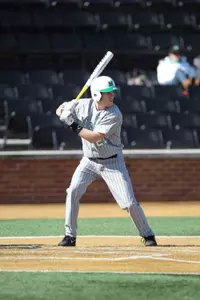
Herd Backstop Reed Excels in the Intangibles
4/8/2014 12:00:00 AM | Baseball
April 8, 2014
By STEVE COTTON
HUNTINGTON, W.Va. -- Since sportswriter Henry Chadwick's first boxscore appeared in the New York Clipper in 1859, baseball has been the ultimate numbers game.
(In case you are wondering, the Brooklyn Stars pulled off a 17-12 upset of the heavily favored crosstown Excelsiors that day.)
To baseball fans, 56, 714 and 2,130 need no further explanation; they tell stories all by themselves. But even in the era of deep-math sabermetrics and modern day statistics like WAR, BABIP and PECOTA, some things can't be quantified.
It's those intangibles that make Marshall catcher Matt Reed stand out.
There are no stats denoting how many runners don't attempt a stolen base because they're wary of Reed's powerful right arm, or of how many wild pitches have been saved due to his expertise at blocking balls in the dirt.
Those things don't show up on the stat sheet, but Marshall Coach Jeff Waggoner, a former catcher, notices each and every one of them.
"As a catcher, your No. 1 priority is to get the most out of your pitching staff," Waggoner said. "The catcher wins games with his defense and by getting the most out of the guys on the mound.
"That's Matt. He's athletic, he throws well and he blocks balls in the dirt. He's also smart with the pitchers and with the way he works with the umpire. I'm glad we finally have him at Marshall."
That's "finally," because Reed's collegiate career began at Clemson, which won the initial recruiting battle for the services of the backstop from Purcellville, Va.
"From the time I got to high school, I was playing on a good travel team that played in big events," Reed said. "I had gotten lots of exposure in front of scouts and college coaches.
"Over the next few years a lot of them started talking to me and recruiting me and in the end it came down to Clemson, Marshall and Maryland - and eventually I went to Clemson."
Reed's time at Clemson was cut short, however, by a bad back brought on by on by the wear and tear of weightlifting and countless batting practice swings, in addition to the rigors of what every catcher goes through behind the plate.
"It wasn't one thing like a collision or getting hit, but it was just an accumulation of things - lots of hitting, lifting, I lost a lot of weight," Reed said. "Eventually I couldn't keep going with it and we found out that I actually had a broken bone in my lower spine. I had a broken back."
Reed's year was over after only four at-bats for the Tigers.
"I was confident that I'd heal up and be fine again," he said. "But Clemson was going in another direction and I decided it was time to start somewhere new and fresh."
After examining several options once again, Marshall became his destination. Reed arrived in Huntington for the fall semester, although his time on the field during the fall practice season was limited as he continued to rehabilitate the back.
"I put in lots of work in the pool and other therapy and didn't play for about three-fourths of the fall season," Reed said. "It was a long, slow process. At times it was aggravating and frustrating, but I got through it and got healthy and strong again."
Healthy enough that he's been the starting catcher in 24 of Marshall's 29 games this season, back behind the plate and wearing the equipment that he's loved since his very first practices in Little League.
"I've been catching since Day 1, really," he said. "When you're in Little League you play some different positions, of course, but I always went back to catcher quickly.
"I liked the fact that the catcher was involved in every play. Even if the batter hits a pitch, you had to be ready to catch it.
"If you're an outfielder, you might go an entire game and only touch the ball once or twice. So I liked catching right from the start from that standpoint, then as I got older I realized I liked the mental part of being a catcher, I realized that my arm was stronger than most and eventually that I was pretty good at it."
That arm is strong enough that opponents are thinking long and hard about trying to run on the Herd. Not only has Reed gunned down half of the runners who have tried to steal, Marshall as a team is among the league leaders in fewest attempted steals by the opposition.
It's not uncommon for him to throw behind runners several times per game, putting it in their heads that they'd best not stray far from the bag.
Not only that, but those same runners have been denied many other opportunities to advance because of Reed's ability to block pitches in the dirt. He displays impressive agility for someone who is 6 feet 3, 185 pounds.
"Whenever there's a runner on base it's in my mind that I have to block the ball," Reed said. "Fastball, curveball, it doesn't matter - it's my job to block it and keep the runners where they are.
"It can be hard to do and it might not be fun sometimes, but that's my job. Keeping that runner from moving up might be the difference between a win and a loss."
That not only results in the immediate benefit of keeping the runners from advancing, but it also makes Herd pitchers more confident and effective.
"In order to be a good pitcher you have to throw your secondary pitches with confidence, especially with runners in scoring position," Waggoner said. "With Matt behind the plate, our pitchers have the trust factor that they can bury that breaking ball when they're ahead in the count and if it's in the dirt he'll block it and keep the runners from moving up."
What excites Waggoner even more is the thought that Reed will be doing this at Marshall for years to come. The Herd will pursue a medical hardship for his year at Clemson, which would allow three more years of eligibility.
"He's just a young guy," Waggoner said of the 20-year-old Reed. "He's going to go play in the Cape Cod League this summer, and he'll work there with the best pitchers in the nation and will improve just because of that.
"Matt wants to be good and works hard, both physically and mentally, to improve as much as he can. He's already very good, but we've just scratched the surface of what he can become."
Steve Cotton is the "Voice of the Herd" on the Thundering Herd/IMG Sports Network. This story also appears in this week's issue of the Herd Insider.