Marshall University Athletics
COTTON: Herd's Warner Stays Cool, Throws Heat
4/20/2016 12:00:00 AM | Baseball
By STEVE COTTON
HUNTINGTON, W.Va. - Bases loaded, nobody out, eighth inning, a 5-4 lead. A trip to the mound; a check of the bullpen. The coach signals for his hard-throwing right-hander.
What's tougher for a pitcher than that?
But Marshall's Burris Warner is not your average reliever. The Thundering Herd junior from Auburndale, Fla., views it as another day at the office - his office consisting of a mound of clay, 18 feet in diameter and 10 inches high.
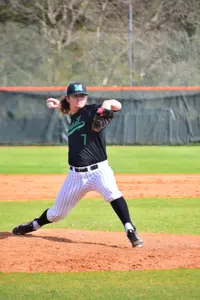
Warner was summoned into that very setting as Marshall entertained Louisiana Tech at Appalachian Power Park on April 1. He coaxed three straight pop flies to the right side - one in foul territory to his first baseman sandwiched between two to very shallow right field - and the Bulldogs were turned away.
After Warner took care of the Techsters again in the ninth, Marshall had a 7-4 win. The April Fool's joke was on LA Tech.
A week later he faced a nearly identical situation - on the road this time, in San Antonio. Marshall led 4-2, bases filled with Roadrunners, none away. This time, Warner entered and struck out three straight UTSA hitters, the deliveries including a fastball that lit the radar guns up at 96 mph. Again he returned for the ninth to complete his save in an 8-3 Herd victory.
So, Warner is on pace to shatter the school's saves record. He has eight for the 19-15 Herd. The current standard is 12 by Austin Coan in 2010.
A self-described "low key, mellow guy," one of Warner's strengths is his ability to remain calm even on the edge of the cliff.
"I don't go in thinking about getting out of it without allowing any runs," Warner said. "My mindset is just to make good pitches and minimize the damage. Then if I can get us out of that it really seems to give the team a spark."
Indeed, when Marshall came to bat in the bottom of the eighth after Warner denied Tech, the Herd added two insurance runs. Marshall plated four in the top of the ninth at UTSA.
"(Warner) is a calm guy who's the same every day when you see him, but when he crosses those lines, man, is he a competitor," Marshall pitching coach Josh Newman said. "He brings a contagious energy and great work ethic and, as good as he's been, he's on a path to keep improving."
Eugene Burris Warner III is by no means a finished product, the mid-90s fastball notwithstanding. He only began pitching in the summer prior to his junior year for the Auburndale High School Bloodhounds. Until then he'd patrolled center field.
"We were playing summer ball and we ran low on pitchers and they just said, 'Hey, we need you to go warm up,'" Warner said. "All I knew to do at first was grab the ball and try to throw it in the strike zone. I realized pretty quickly that there was a lot more to pitching that I'd ever thought about."
Even without much experience on the mound, Warner's powerful right arm made people notice and he committed as a high school junior to pitch for Seminole State Community College, about 75 miles away in Sanford.
He began his freshman year at Seminole State as a starter, but transitioned to the bullpen and then did the same thing as a sophomore. Despite his lack of a defined role, Warner's fastball was now consistently in the low 90s and he'd become a major college prospect.
Florida Atlantic wanted him. At one point he thought he'd accept an offer to Florida and another time to Kentucky, but nothing felt quite right and he kept his options open all the way into last summer.
Warner suited up for the Sanford River Rats in the highly competitive Florida League, a wood bat circuit featuring top college talent. A fellow River Rat was Marshall third baseman/pitcher Tyler Ratliff, who knew a gem of an arm when he saw it.
"Tyler and I were talking and when he found out I hadn't signed anywhere yet he asked if I might be interested in Marshall," Warner recalled. "I said, 'Sure, I'll listen.'
"So he told the coaches about me and they then got in touch and eventually came to see me pitch. Then I made a visit to Marshall and liked it and committed."
The day after he committed, Warner received an offer from Ohio State, but his mind was made up.
"I had committed to Marshall, and that's that," he said. "Once I made that commitment to the school I wasn't going to back out of it."
Warner moved to Huntington last fall and this time there was no indecision about his role. The Thundering Herd coaches wanted him on the mound at the end of games.
"When I got here to Marshall and started working with Coach Newman, some things really started falling into place," Warner said. "We made a couple of adjustments that helped me gain command of my fastball, and my other pitches, too, and it has made a big difference.
"My biggest thing was being able to repeat my mechanics. The way I go about it is that I just try to pick out something to work on and improve upon every single day ââ'¬Â¦ keep making progress."
Warner estimates he throws between 80 and 90 percent fastballs in any given appearance, and his attention to detail and work ethic are appreciated by his pitching coach.
"The development that he's shown since showing up in the fall is tremendous," Newman said. "He works hard at it. He generates a lot of power from his lower half and has a short, quick arm such that the ball jumps on guys."
Some closers are reserved for the ninth inning, but Warner's experience in other roles and Coach Jeff Waggoner's long-held philosophy of using his closer earlier if needed fit perfectly.
Two days after his six-out save in the series opener at UTSA, Warner pitched the last three innings and was credited with the win in the Sunday rubber match.
"Since I did spend time as a starter, pitching two or even three innings is not that unusual for me," Warner said. "I like the way we attack those situations. If they think there's a situation where they need me in the eighth inning, or even the seventh inning, because there are guys on base and the game might be won or lost right there, I want to be the guy who comes in then.
"If I do the job and get us out of a jam in the eighth, then we'll figure out the ninth."
The biggest change in his permanent move to the bullpen was in learning to be ready every single time the Herd takes the field.
"Depending on how the game is going, by the bottom of the sixth or top of the seventh inning I go to the bullpen - since I know the coaches won't hesitate to bring me in for a couple of innings," Warner said. "I start out by stretching and at this point, after I'm stretched out, now I can be warmed up and ready to go into the game with as few as 10-12 pitches.
"I've developed the routine to make sure I'm ready to throw on back-to-back days, or to throw two out of three days. I'm learning a lot about how to do that, both physically and mentally.
"It's not easy - you have your bad days - but it's really growing for me."
Warner also feels that this year's Herd has what it takes to advance to the C-USA Tournament in Hattiesburg, Miss., which would make it Marshall's first appearance since 2010.
"It is a long season and you hit some bumps," he said. "But we've meshed as a team and we have a good mindset to set ourselves up well for the tournament."
Veteran play-by-play broadcaster Steve Cotton - a record 10-time West Virginia Sportscaster of the Year -- is in his 23rd season on the Thundering Herd/IMG Sports Network. This story first appeared in this week's Herd Insider magazine.